Facility providers supporting pharmaceutical firms need to master process validation, not just to satisfy regulators but to deliver a reliable infrastructure that keeps production flowing smoothly while maintaining compliance with standard operating procedures and keeping inspectors satisfied. Through consulting work on cleanroom setups and validation protocols, I have witnessed how a strong understanding of this discipline can make or break client relationships. Let us break this down step by step using real-world examples I have encountered over the years. For an entity that is responsible for ensuring every batch of medication meets exact quality marks without deviation, with no chance of error, process validation serves as the foundational standard.
Core Purpose
At its heart, process validation proves that your manufacturing setup, equipment, utilities, and procedures consistently produce drugs meeting their specifications for quality, safety, and effectiveness. Think of it as the backbone of good manufacturing practices (GMP). Without it, you would risk batches failing potency tests or harboring contaminants, leading to recalls that cost millions and damage reputations.
I remember a mid-sized injection plant where inconsistent mixing led to uniformity issues. Once they validated the process, documenting how variables like agitator speed affected tablet dissolution, variability dropped by 40%. The goal was to build confidence that even with raw material fluctuations or operator shifts, the end product stays within critical quality attributes (CQAs) like purity levels or particle size. Regulators like the FDA demand this documented evidence across the entire lifecycle, from scale-up to routine production. For facility providers, this means your HVAC systems, steam generators, and cleanrooms must support these controls right from the design.
It is not a one-off checklist either. Validation catches drifts early, say, a pump wearing down over time, that could otherwise escalate into noncompliance. In practice, it ties directly to risk management, ensuring your clients’ products are efficacious every single time.
Three-Stage Framework (FDA 2011 Guidance)
The FDA’s 2011 guidance laid out a life cycle approach that is still the gold standard in 2026, shifting from traditional batch testing to proactive science. I have walked teams through this framework countless times, and it always starts with planning.
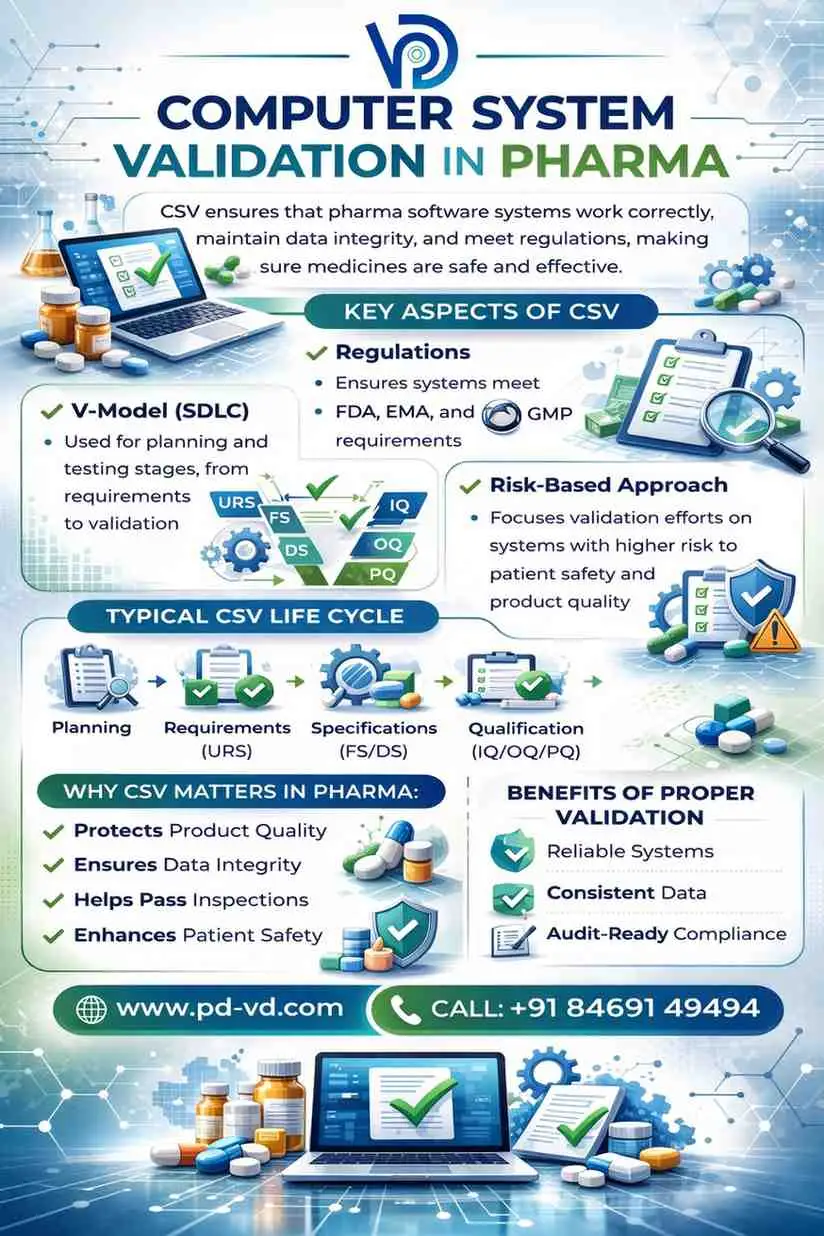
Stage 1: Process Design.
This is the blueprint phase. You map out the commercial process based on lab data, pilot runs, and design of experiments (DOE). Identify critical process parameters (CPPs) — such as drying temperature or pH — that impact CQAs. Tools like failure mode and effects analysis (FMEA) help prioritize risks. In one facility retrofit I advised, we spent weeks characterizing raw material variability, establishing proven acceptable ranges (PARs) before engaging with production equipment. The output was a control strategy that guides everything downstream.
Stage 2: Process Qualification.
This is where theory meets reality. First, qualify your facility assets: installation qualification (IQ) confirms equipment is in place per specifications; operational qualification (OQ) tests it across ranges; performance qualification (PQ) simulates full loads. Then comes process performance qualification (PPQ), usually three consecutive full-scale runs under worst-case scenarios. Protocols detail sampling, testing, and out-of-spec handling. A vial filling line I validated ran 50,000 units per batch, with inline particle checks ensuring sterility. Cut corners here, and you are risking FDA Form 483 observations.
Stage 3: Continued Process Verification.
Validation does not end at PPQ; it is ongoing surveillance. Track trends via statistical process control (SPC) charts, process analytical technology (PAT) sensors, and annual product reviews. If dissolution times creep up, you investigate root causes like filter clogging. Facilities I have equipped with real-time monitoring dashboards cut reaction times from weeks to hours, keeping processes in control.
This staged model demands tight integration; your cleanroom air handlers must maintain validated airflow during all three phases.
Types and Best Practices
Validation is not one-size-fits-all; it adapts to your scenario. Prospective validation is standard for new products: design, qualify, and verify before launch. Concurrent validation runs during early production, when patient needs are urgent, like during shortages, review each batch retrospectively. Retrospective validation examines historical data for legacy products, though regulators do not accept it without strong justification.
Best Practices:
Risk-based approach. Use Ishikawa fishbones or HAZOP to focus on high-impact steps, avoiding over-validation of low-risk blending.
Worst-case testing. Simulate extremes such as the coldest water or hottest ambient temperatures to prove robustness.
Documentation rigor. Validation master plans (VMPs), protocols, reports, batch records, and everything traceable. Digital validation lifecycle management systems (VLMS) we install now automate this, significantly reducing paper trails.
Batch size justification. Three batches minimum, but scale with statistical analysis for confidence (e.g., 95% power).
Cross-functional teams. QA, engineering, and operations: I have seen siloed efforts fail audits.
In sterile fill-finish suites, we layer cleaning validation atop this, swabbing “hardest-to-clean” spots after worst-case soil conditions. Emerging trends like continuous manufacturing demand hybrid models with digital twins for virtual PPQs. Always train operators; human error remains the leading cause of deviations.
Final Thoughts
Process validation should not be seen as bureaucracy. It should be seen as your competitive edge as a facility provider. By future-proofing pharma clients against changing regulations like the European Medicines Agency’s real-time release testing push or FDA data integrity scrutiny, facilities that incorporate it from day one experience fewer deviations, faster approvals, and loyal partners. When setting up a new line or line extension, start by conducting a gap assessment against lifecycle models to identify areas for improvement. Need help with IQ/OQ protocols or PAT integration? We specialize in turnkey solutions that make validation seamless. Contact us today to discuss how we can support your validation journey.