

The importance of regulatory oversight cannot be overstated in the pharmaceutical industry, where even a small oversight can impact the safety of patients globally. Compliance and quality are not optional; they form the foundation that allows drugs to reach patients safely and consistently. Poor manufacturing controls or inadequate lab testing can lead to contamination of batches, inaccurate studies, or costly regulatory delays. Two regulatory frameworks help prevent these problems. The difference between GMP and GLP determines how each safeguards quality in pharmaceuticals.
Good Manufacturing Practice (GMP) and Good Laboratory Practice (GLP) are often mixed up because they both focus on quality and play important roles throughout the drug development lifecycle. Proper GMP pharmaceutical documentation helps quality teams apply the appropriate guidelines at the correct stage of development. This article outlines these frameworks, their key differences, applications, documentation requirements, regulatory importance, and why both GMP and GLP are essential to the pharmaceutical industry.
What Are GMP and GLP?
Good Manufacturing Practice (GMP) is a legal framework that sets standards for how pharmaceutical products are manufactured, tested, and released. The framework covers equipment, facilities, personnel training, and quality assurance, all of which are designed to ensure the production of high-quality, safe medicines.
Good Laboratory Practice (GLP) is a regulatory framework that governs how non-clinical research studies in laboratories are planned, conducted, and reported. The focus is on data integrity, adherence to study protocols, and the competence of personnel conducting safety and toxicology studies.
GMP is primarily used for pharmaceutical and biotechnology manufacturing, whereas GLP is primarily applied to preclinical research and safety studies submitted to regulatory authorities.
Both frameworks protect patient safety, but they apply at different stages of the drug development lifecycle. GLP regulates early-stage research, generating the safety data required before a drug enters human clinical trials. GMP regulates the manufacturing process, ensuring that drugs are consistently produced for clinical use and commercial distribution. Together, they create a continuous quality system that extends from early research through commercial manufacturing.
Why GMP and GLP Matter?
GMP and GLP protect public health at two distinct stages of drug development. GLP ensures laboratory studies produce reliable and trustworthy data, allowing safety decisions to be based on sound scientific evidence. GMP ensures that once a product enters manufacturing, it remains safe, effective, and consistent for patients.
Without these frameworks, manufacturing errors could go undetected, while flawed studies could mislead regulators and delay approvals. International regulatory bodies must verify compliance before approving any new drug. This makes compliance essential for gaining access to global markets. Strong compliance also builds trust among healthcare professionals, regulators, and patients who rely on these medicines.
Key Comparison Factors Between GMP and GLP
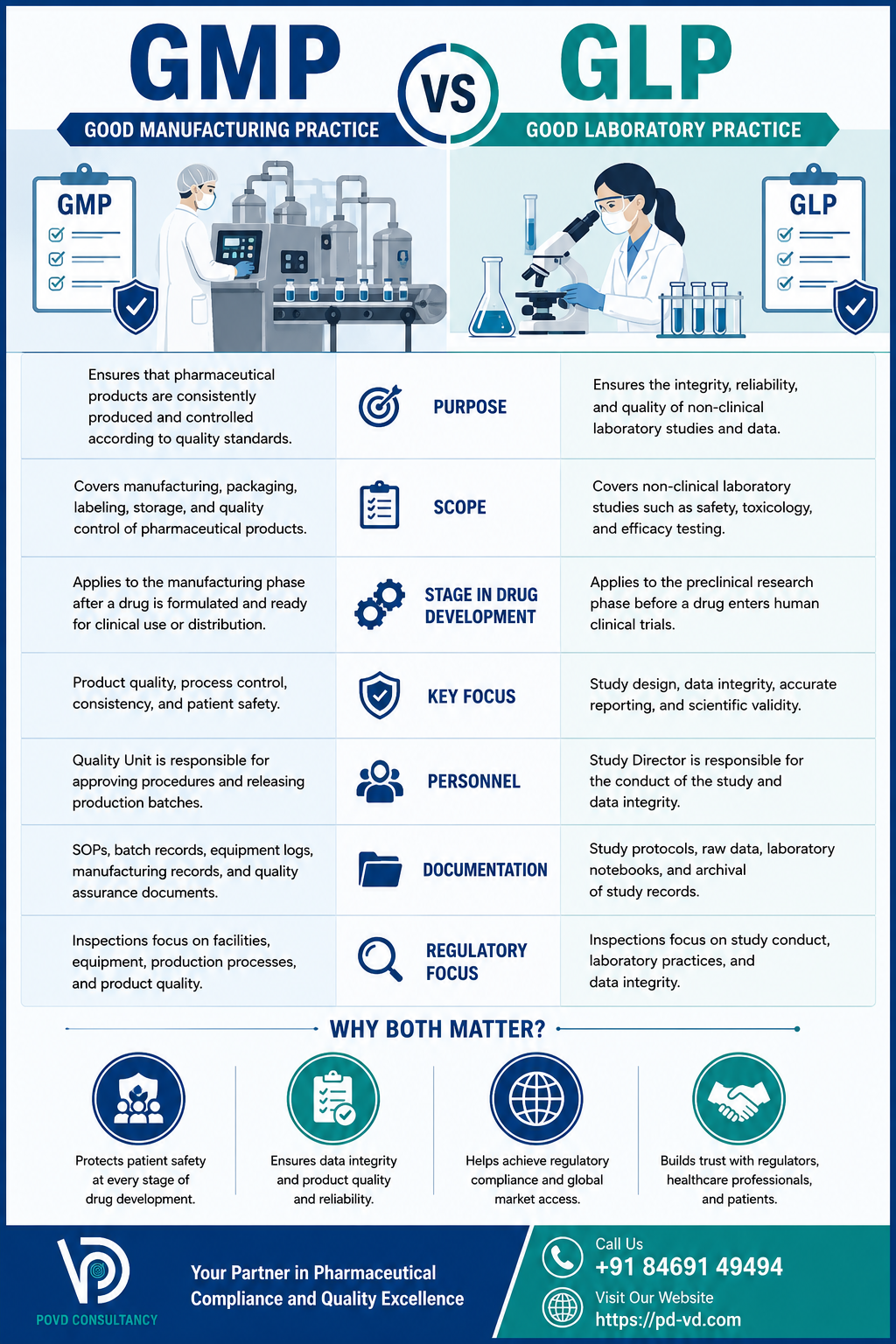
Purpose
GMP is designed to ensure consistent product quality and safety throughout the manufacturing process. GLP is intended to ensure the integrity of non-clinical studies and the reliability of the data they generate.
Scope
GMP covers manufacturing, packaging, labeling, storage, and quality control. GLP covers non-clinical laboratory studies, including toxicology and safety testing.
Stage
GMP applies once a drug formulation enters clinical or commercial manufacturing. GLP is used during the earlier preclinical research and development phase.
Personnel
Under GMP, the Quality Unit is responsible for approving procedures and releasing production batches. Under GLP, the Study Director oversees each study and is responsible for ensuring its scientific integrity and accurate reporting.
Documentation
GMP is based on standard operating procedures (SOPs), batch records, equipment logs, and manufacturing documentation. GLP depends on study protocols, raw data records, laboratory notebooks, and archiving procedures.
Regulatory Focus
GMP inspections focus on manufacturing facilities, production processes, equipment validation, and product quality. GLP inspections evaluate laboratory practices, study conduct, and data integrity.
GMP and GLP have different functions; however, they work together to ensure pharmaceutical quality and patient safety throughout the entire drug lifecycle.
GMP Explained
Good Manufacturing Practice, outlined in regulations such as 21 CFR Part 211, covers every stage of pharmaceutical production. Its primary objective is to ensure that every batch meets the same high standards of quality, safety, and consistency.
GMP requires manufacturers to validate manufacturing processes, qualify equipment, and maintain clean, well-controlled facilities to prevent contamination. Employees must be properly trained and their training documented before performing any activity that could affect product quality.
Batch manufacturing records document every step of the production process, from raw material handling to final packaging. Quality Assurance (QA) teams review production records and evaluate batches at multiple stages before product release. If something goes wrong, GMP requires a formal investigation into the root cause, followed by the implementation of Corrective and Preventive Actions (CAPA).
Core GMP Requirements Include:
- Validated processes: Manufacturing methods and equipment must be qualified and validated before use.
- Trained staff: Personnel must demonstrate documented competency for tasks that affect product quality.
- Clean facilities: Controlled environments must be maintained to prevent contamination.
- Batch records: Accurate and complete documentation of every production step is required.
- Quality Control (QC) testing: Products must undergo testing at critical stages before release.
- CAPA procedures: Formal processes must be followed to investigate deviations and prevent recurrence.
GLP Explained
Good Laboratory Practice, outlined in regulations such as 21 CFR Part 58, provides the framework for conducting non-clinical laboratory studies that generate safety data for regulatory submissions. Its primary objective is to ensure that research is scientifically reliable, reproducible, and trustworthy.
Each GLP study begins with an approved written protocol that clearly defines the study objectives, methodology, and procedures before any work begins. The Study Director oversees the entire study and is responsible for its scientific integrity and overall conduct.
Raw data must be accurately recorded at the time observations are made and remain fully traceable throughout the study. Equipment must undergo routine calibration, while samples must be handled, stored, and documented in accordance with established procedures. An independent Quality Assurance (QA) unit monitors study activities to ensure compliance with GLP standards.
Major GLP Principles Include:
- Written protocols: Approved study plans must be established before the study begins.
- Study Director’s responsibility: A single individual is accountable for the scientific integrity and execution of the study.
- Accurate records: Data must be recorded as observations occur and should never be reconstructed later.
- Calibrated equipment: Laboratory instruments must undergo regular calibration and maintenance.
- Independent QA review: Quality Assurance personnel independently monitor study conduct and compliance.
- Long-term archiving: Study records and raw data must be securely stored and remain retrievable for future regulatory review.
GMP vs. GLP Comparison Table
|
Factor |
GMP |
GLP |
|
Definition |
Standards for pharmaceutical manufacturing |
Standards for non-clinical laboratory studies |
|
Primary Objective |
Product quality and safety |
Data integrity and reliability |
|
Scope |
Manufacturing, packaging, storage |
Preclinical research, toxicology testing |
|
Applicable Activities |
Drug production and release |
Safety studies before human trials |
|
Responsible Personnel |
Quality Unit (QA) |
Study Director |
|
Documentation |
SOPs, batch records |
Study protocols, raw data |
|
Regulatory Focus |
Production facilities and manufacturing processes |
Study conduct and data integrity |
|
Inspection Criteria |
Equipment validation, production records, batch history |
Protocols, raw data, QA oversight, archiving |
|
Outcome |
Consistent, safe pharmaceutical products |
Reliable and trustworthy scientific data |
|
Examples |
Tablet manufacturing |
Toxicology testing |
Common Misconceptions About GMP and GLP
GMP and GLP are not interchangeable. GLP does not govern manufacturing, and GMP does not replace the quality systems required for laboratory research. These frameworks serve different purposes within the pharmaceutical product lifecycle.
Compliance with GMP and GLP involves much more than maintaining documentation. It also requires properly trained personnel, validated processes, standardized procedures, accurate recordkeeping, and ongoing quality oversight. Pharmaceutical companies need both frameworks working together to ensure product quality, data integrity, and regulatory compliance. Neither framework replaces the other.
Conclusion
GMP and GLP share the common objective of ensuring that medicines are safe, effective, and supported by reliable scientific research. GMP focuses on maintaining consistency and quality throughout pharmaceutical manufacturing, while GLP ensures the accuracy, integrity, and reliability of non-clinical laboratory studies. Understanding the difference between GMP and GLP helps quality managers, researchers, and manufacturers apply the appropriate regulatory standards at every stage of the drug development lifecycle.
Strong compliance with these frameworks reduces regulatory risks, minimizes costly delays, and builds long-term confidence among regulators, healthcare professionals, and clients. If you require assistance in auditing or strengthening your GMP and GLP compliance systems, contact PD-VD Consultants, a trusted regulatory affairs consulting firm, for a free consultation and ensure your quality processes are fully prepared for regulatory inspections and audits.